
Kallakurichi
Kallakurichi District was initially declared as the 33rd district of Tamil Nadu on January 8, 2019, by the Hon'ble Chief Minister during the assembly session. Later, it was reclassified as the 34th district on November 26, 2019, following the inauguration of Tenkasi as the 33rd district. The district was formed by splitting Viluppuram District as per G.O. (MS). No. 424 and 425, Revenue and Disaster Management Department, Revenue Administration Wing, {RA 1(1)} Section, dated November 12, 2019.
Kallakurichi District consists of 2 revenue divisions, 6 taluks, 7 circles, 562 revenue villages, and 24 firkas. It includes 9 development blocks and 412 village panchayats. The inauguration of Kallakurichi as the 34th district was celebrated with a grand function attended by the Hon'ble Chief Minister.
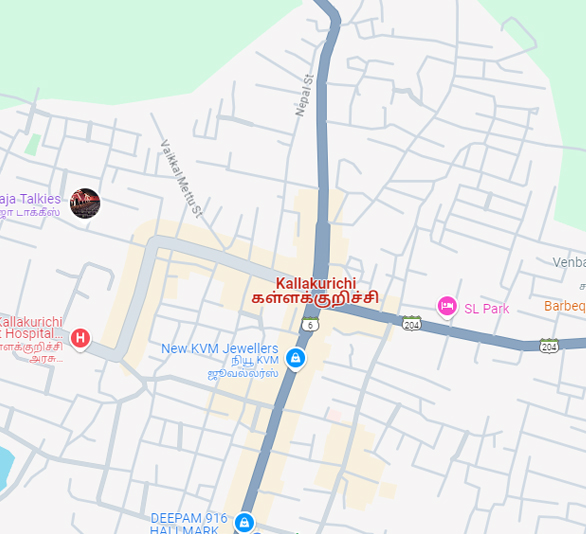

Geographical and Historical
During ancient times, the region was ruled by the Cholas, Pallavas, and local chieftains like the Malaiyaman of Tirukoilur. Known as Nadu Nadu due to its location between Chola Nadu and Thondai Nadu, it later came under the control of the Gingee Nayaks and Arcot Nawabs. During British rule, it was part of the South Arcot District of the Madras Presidency.
Kallakurichi is bordered by:
- Thiruvannamalai District to the North
- Villupuram District to the East
- Dharmapuri and Salem Districts to the West
- Perambalur and Cuddalore Districts to the South
Geography
The district's terrain includes metamorphic rocks from the gneiss family and various sedimentary rock formations. The Kalrayan Hills, part of the Eastern Ghats, are a prominent feature. Major rivers such as the Thenpennai, Manimukthar, Gomukhi, and Gadilam flow through the district, with irrigation primarily from lakes, canals, and wells.
History
During ancient times, the region was ruled by the Cholas, Pallavas, and local chieftains like the Malaiyaman of Tirukoilur. Known as Nadu Nadu due to its location between Chola Nadu and Thondai Nadu, it later came under the control of the Gingee Nayaks and Arcot Nawabs. During British rule, it was part of the South Arcot District of the Madras Presidency.
Taluks
- Kallakurichi
- Sankarapuram
- Chinnasalem
- Ulundurpet
- Tirukkovilur
- Kalvarayan Hills
Municipalities
- Kallakurichi
- Thirukovilur
- Ulundurpet
Town Panchayats
- Sankarapuram
- Chinnasalem
- Thiyagadurugam
- Vadakkanandal
- Manalurpet
Panchayat Unions
- Kallakurichi
- Sankarapuram
- Thirukovilur
- Rishivandiyam
- Thiyagadurugam
- Ulundurpet
- Chinnasalem
- Thirunavalur
- Kalvarayanmalai
Infrastructure
Transport
Railways
Chinnasalem Railway Station on the Salem – Vridhachalam Railway Line.
Highways
The Kallakurichi National Highway, mainly referring to NH 79 and NH 68, connects several important towns and cities in Tamil Nadu:
- Kallakurichi: The central town on this route in Villupuram district.
- Salem: A major industrial city connected via NH 79, which also links to Dharmapuri and Hosur.
- Ulundurpet: A key town on NH 68, connecting Kallakurichi to Villupuram.
- Villupuram: A major town that links Kallakurichi to Chennai and other parts of Tamil Nadu.
- Tiruvannamalai: A spiritual town connected to Kallakurichi by nearby roads.
- Attur: A town near Salem, acting as a junction on NH 79.
- Chennai: The capital city of Tamil Nadu.
- Tirupati: A popular pilgrimage city in Andhra Pradesh, reachable from Kallakurichi via Villupuram and connecting roads.
Economy and Agriculture
Kallakurichi is predominantly an agricultural district, often referred to as the “Home of Agriculture.” Key crops include paddy, maize, sugarcane, and urundu. The region benefits from irrigation through rainfall, the Gomukhi and Manimukta dams, and lake irrigation.
The district hosts various industries, including over 10 rice processing units, textiles, jewelry, agricultural feeds, sugar mills, and solvent extraction plants. Poultry farming is also significant.
Education
The district has numerous colleges and schools, both government and private. Notable institutions include:
- Kallakurichi: The central town on this route in Villupuram district.
- Government Kallakurichi Medical College
- Government Arts College
- Polytechnic College
- Industrial Training Institute (ITI)
In March 2020, the Chief Minister of Tamil Nadu announced the establishment of a new medical college near Pumputhottam in Siruvangur village, just 3.5 kilometers from Kallakurichi town. The project received initial funding of ₹370 crores, and the first batch of 150 students started in the academic year 2021-2022.
Cultural and Natural Highlights
Kalvarayanmalai
Covering 550.70 hectares, featuring Periyar, Megam, and Sirukalur waterfalls, along with the small Tirupati temple and tribal populations.
Temples
Notable temples include Ulagalanda Perumal Temple in Thirukovilur, Veerataneshwara Temple, Kapilar Hill, Lakshmi Narasimha Temple in Ulundurpet Parikkal, Thiruvarangam Adhirangan Ranganathaswamy Temple in Shankarapuram, and Rishivanthiyam Arthanareeswarar Temple.
NGO in Kallakurichi
Sengodu Foundation
The Sengodu Foundation began its operations in 2024 as a registered NGO and Trust, focusing on the Kallakurichi district and Chinnasalem area. The organization is officially registered at the Chinnasalem Registration office and with NGO Dharban. It has also secured 12A, 80G, and CSR certifications, allowing it to issue 80G certificates to its donors.
The foundation’s initiatives cover a range of areas including Education, Healthcare, Environment, Rural Development, and Food. The Sengodu Foundation operates through various entities such as Chinnasalem NGO, Chinnasalem Trust, Kallakurichi Trust, and Kallakurichi NGO. These entities collaborate under the Sengodu Foundation’s umbrella to effectively address community needs, optimize resource use, and enhance their collective impact on society.